
Where BOP Releases Go
The Federal Bureau of Prisons manages sentenced federal prisoners. It is not Madison County’s jail and does not hold every federal defendant. A person prosecuted federally may first remain under U.S. Marshals Service control, sometimes in a local or contract facility, before BOP designation. After a BOP sentence, release can lead to the community, a residential reentry setting, federal supervised release, immigration custody, or another authority with a lawful hold.
A BOP result showing a past release date and language such as released or not in BOP custody supports one narrow conclusion: BOP custody ended on that date. It does not establish what happened in CVRJ, whether supervision continues, or whether a new custodian took control. Check the federal judgment and docket for the sentence and supervised-release terms. Follow any documented transfer to the receiving system.
| Federal stage | Best source |
|---|---|
| Federal pretrial custody | Federal court orders and limited USMS confirmation |
| Designated BOP prisoner | BOP Inmate Locator |
| Former BOP prisoner | BOP past release date, FOIA, and federal docket |
| Transfer to ICE | ICE locator and ERO contact |
Search Federal Release Records
Use the official BOP Inmate Locator. Search by BOP register number when known. The tool also accepts DCDC, FBI, or INS numbers. A name search can be narrowed with age, race, and sex. Exact identity matching matters because names recur and demographic data can be incomplete or change over time.
- Choose the identifier search when a federal number is available.
- Otherwise enter the full name and useful demographic filters.
- Open the matching result and record the register number.
- Read the release date and location or status together.
- Compare the result with the federal judgment and later custody records.
BOP says the result set generally covers federal prisoners released after 1982 and is updated daily. Older federal prison records may require the National Archives. A future release date can change because of sentence-credit calculations or legal action. Do not turn a projected federal date into an assertion that release occurred.
Read BOP Release Results
The BOP record explanation identifies name, register number, age, race, sex, release date, and location as standard public result fields. A location field can name an institution, a community placement, or show that the person has been released. Preserve the exact wording and date. The public locator is a finding aid, while the agency record and court judgment provide the stronger paper trail.
| Result field | What it establishes | What it does not establish |
|---|---|---|
| Register number | Federal identity key | State or county booking identity |
| Release date | BOP’s listed past or future date | Community freedom from all holds |
| Released status | BOP custody ended | End of supervised release |
| Institution/location | Reported BOP placement | Real-time USMS or ICE status |
The BOP locator is not a CVRJ release source. If a Madison local arrest began the custody trail, request CVRJ’s release or transfer entry as well. The Madison County release search shows how to keep county, state, federal, and immigration records in their proper lanes.
Request BOP Release Records
For certified or more detailed federal prison material, use the BOP FOIA channel. Identify the person by full name and register number, describe the date range, and name the existing record sought. Useful release-oriented fields include commitment, facility, release date, and the recorded custody status or destination to the extent publicly releasable. Expect privacy and law-enforcement limits.
The federal criminal docket supplies a different part of the proof. The judgment states the sentence and any supervised-release term. Later orders can modify custody or supervision. BOP calculates and administers the prison term, while the sentencing court controls its orders. Keep both sources rather than asking one agency to recreate the other’s record.
- BOP custody
- Federal imprisonment administered by the Bureau of Prisons.
- USMS custody
- Federal prisoner management often used before trial and designation.
- Supervised release
- Court-ordered federal supervision after prison, not more BOP imprisonment.
- Detainer
- A notice or basis for another authority to seek custody.
USMS Release Record Limits
The U.S. Marshals Service prisoner information explains why a BOP no-result can be inconclusive for a federal pretrial defendant. USMS handles many prisoners before trial and during movement. Its public disclosure is limited and generally verifies only whether a person is in federal custody. It does not provide a broad public roster equal to the BOP locator.
Federal courts decide bond, release, or remand. “Remand” means the court directs that a person remain or return to custody. Check the docket or clerk’s order when the person has not yet reached BOP. After conviction, most sentenced federal prisoners move to BOP, though very short sentences may remain in USMS-managed custody.
Note: A BOP no-result before designation is not proof of federal release; the federal docket is the key legal source.
Madison Federal Transfer Checks
A Madison County arrest does not automatically become a federal case. Use the federal route only when the record shows federal prosecution, a federal writ, or transfer. If CVRJ ended custody by handing the person to USMS or BOP, describe the event as a transfer. Request the receiving agency field from CVRJ and then search by the federal identifier.
Federal release also does not end a state hold or immigration process. A person can leave BOP and enter ICE custody. Another jurisdiction may act on a warrant. Read each event in order, with one custodian ending and another potentially starting. This prevents the word “released” from being stretched beyond the agency that reported it.
The local and federal records answer different questions. CVRJ can document its own physical exit and receiving authority. The federal docket records bond, remand, judgment, and later court orders. BOP reports its prison custody and release date. A sound Madison County timeline keeps all three sources instead of allowing one result to stand for every stage.
BOP Release Date Changes
A future BOP date is not fixed proof. Federal sentence credits, recalculation, court action, and other lawful changes can move the date before release occurs. Read the field as BOP reports it and note when the page was checked. If the date passes while the locator still shows custody, contact the responsible federal source rather than declaring an error or converting the projection to a past event.
A past release date also has boundaries. It confirms the end of the listed BOP term but may be followed by supervised release, another sentence, immigration detention, or a later arrest. The federal judgment states the supervised-release term, while the locator focuses on BOP custody. For a precise history, pair the locator result with the judgment and any later custody record.
View BOP Release Search
The official BOP locator source shows the national search route used for current and former federal prisoners.
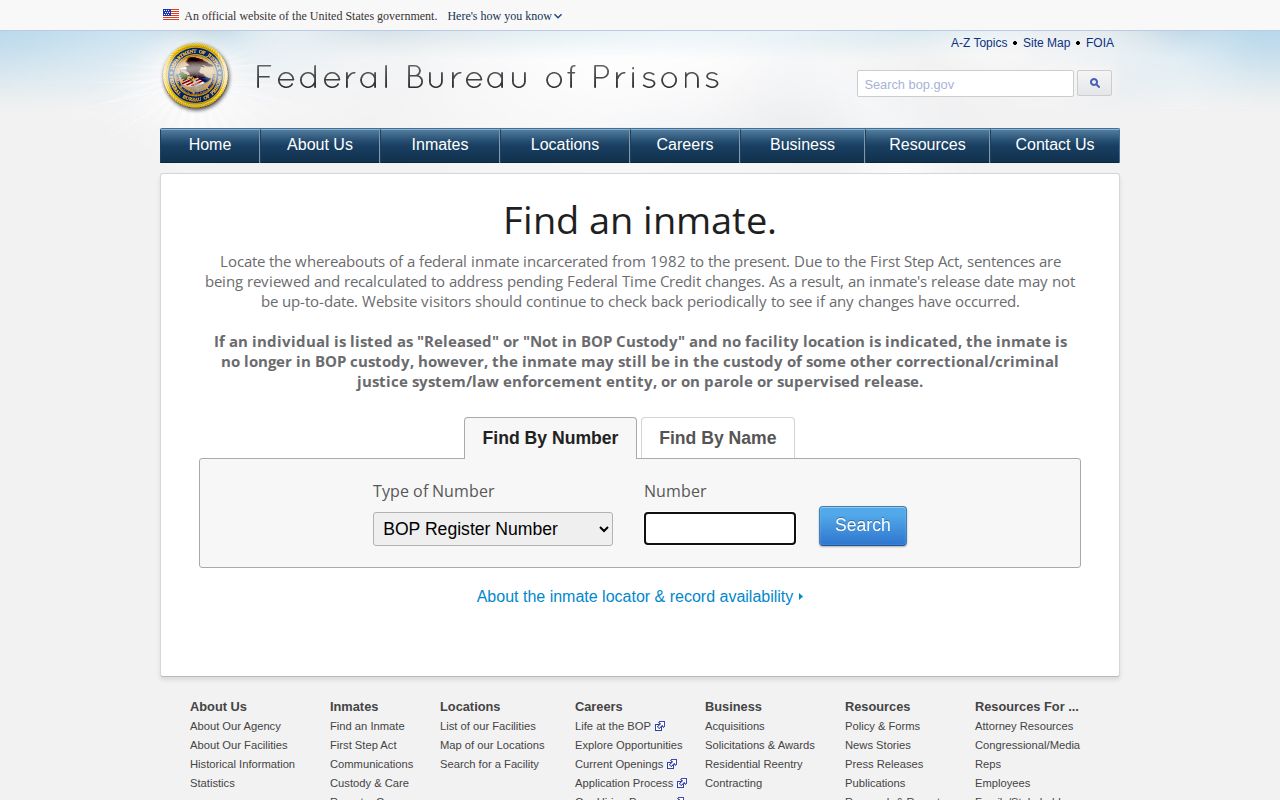
The captured locator reinforces the federal-only boundary: its release date belongs to BOP custody and cannot replace a CVRJ or VADOC record.
Preserve BOP Release Proof
A locator result is easy to revisit, but it should not be the only record kept when the exact federal release matters. Record the register number, full displayed name, date, location or status text, and the date of access. Then obtain the federal judgment and any later order that changed the sentence. A BOP FOIA response can supply existing agency material that is publicly releasable and responsive to a focused request.
Older federal custody needs a different route. BOP states that its online data generally reaches people released after 1982. A no-result for an earlier federal term can therefore lead to the National Archives rather than a conclusion that the person was never incarcerated. Use the court case and known institution to frame that historical search. Exact identifiers reduce the risk of attaching another person’s federal record.
Federal custody may end in stages. Prison release can be followed by a court-ordered term of supervised release. That supervision is administered in the community and is not the same as remaining in a BOP institution. A later detainer or immigration handoff can begin a different custody event. State each stage separately, and never use a single BOP status to summarize an entire Madison, state, and federal history.