
Madison VINELink Custody Coverage
Central Virginia Regional Jail prominently links to VINE for custody checks and alerts. CVRJ serves Madison and four other member counties, so a Madison search should identify both the person and the reporting facility. The service is person-specific. It is not a Madison-only roster, a list of everyone released today, or a permanent release ledger.
Virginia Jail VINE covers participating local and regional jail custody events. Available events can include release, transfer, death, escape, and return, though optional labels depend on the data provider. Do not promise that every event or field appears on every CVRJ record. An affirmative status or notice that custody ended is evidence about the reporting jail. It does not establish that no other agency took custody.
State custody has a different notification path. VADOC uses NAAVI for qualifying victim notifications involving state prisoners. Jail VINE and NAAVI are not connected, and enrollment does not transfer between them. A person released from a VADOC facility to supervision may appear in the public VADOC locator, but NAAVI does not cover probationers or parolees as an ongoing supervision tracker.
Madison’s court trail remains useful after a notification ends. General District Court may show bond, misdemeanor disposition, or the early stages of a felony matter. Circuit Court may hold the final felony order. Those records explain the legal action, but they do not replace CVRJ’s physical exit time. Use the court entry to interpret the event, then obtain the jail record when the distinction between order and completed release matters.
Search a Madison Inmate on VINELink
Open the official Virginia VINELink entry and search one person using the name or identifier fields offered. If several records resemble the person, compare the lawful identity details and reporting agency before opening a result. Name alone is weak evidence. A booking number, DOC ID, court case number, or other verified identifier provides a safer match when available.
- Choose Virginia and begin the inmate search from the official VINELink service.
- Enter the person’s first and last name, plus an identifier if the form offers one and it is known.
- Review possible matches and select the record tied to Central Virginia Regional Jail when local Madison custody is expected.
- Read the displayed status, reporting facility, event detail, and timestamp exactly as labeled.
- Save the status and register for alerts if continuing notice is needed.
If no matching record appears, check spelling and identifiers, then contact CVRJ at 540-672-3222. A no-result does not prove release. The person may be under another spelling, in a system VINE does not cover, newly transferred, or outside the service’s displayed scope. For the full set of custody-specific alternatives, use the Madison County released inmate search.
The successful manifest capture below shows the official person-check interface. Visit the VINELink source for the live search.
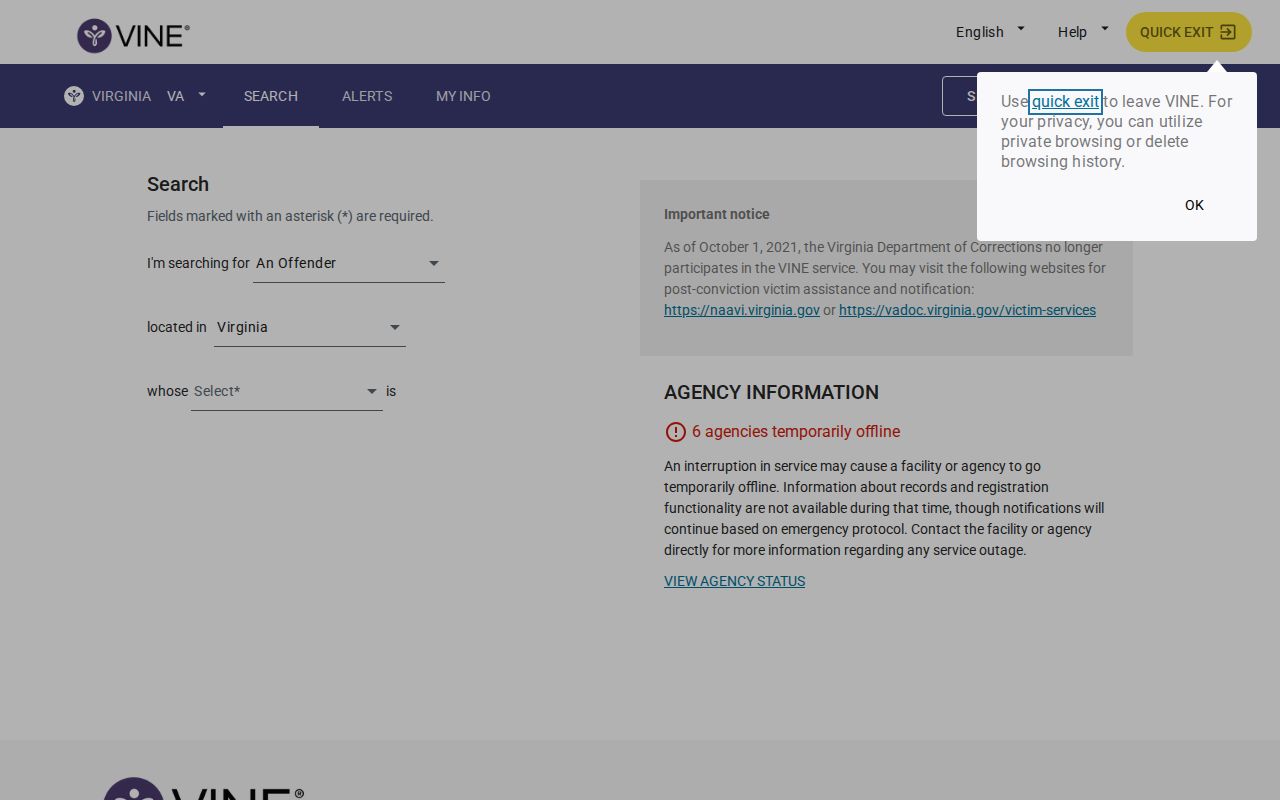
The live record must still be matched to CVRJ and the intended person rather than accepted on a shared name.
Madison VINELink Release Fields
VINELink displays only the information supplied by a participating agency and allowed in the service. Because the research did not capture a privacy-safe released CVRJ result, no exact released-status wording should be invented. Read the current label on the matching record. An affirmative release event means the reporting custodian ended that event, while disappearance from search does not carry the same meaning.
| VINELink item | How to use it |
|---|---|
| Custody status | States what the participating reporting agency currently provides. |
| Agency or facility | Identifies whether the record concerns CVRJ or another participating custodian. |
| Identity details | Help separate people with similar names within the limits of the display. |
| Custody event | May identify a reported release, transfer, return, or other available event. |
| Event timestamp | Shows when the supplied event was recorded or reported, as labeled. |
| Notification option | Lets a user enroll through available phone, text, email, TTY, or in-app methods. |
A transfer field matters most. Release from CVRJ to VADOC, another jail, federal custody, or ICE is not community release. If the result indicates a transfer, continue with the receiving agency. If it reports release without enough context, compare the event with the CVRJ release record and Madison court order.
Note: Court records explain the legal decision, while VINELink reports a participating custodian’s event and may update on a different schedule.
Register Madison VINELink Release Alerts
After selecting the correct person, open the notification option and choose from the methods the service currently offers. The official Virginia material lists text, telephone, email, TTY, and in-app notice. Some events are optional and provider-dependent, so registration should be read as a request for available notices rather than a guarantee that every possible custody change will produce the same label.
- Open the matching CVRJ person record and choose the notification or “get notified” option.
- Select each available delivery method that fits the need.
- Enter the phone number, email address, or other contact information requested.
- Create a PIN for telephone notifications and follow all confirmation directions.
- When a VINE call arrives, enter the PIN to confirm receipt and stop repeat calls.
Keep the alert message and note its timestamp. Jail VINE stops sending updates after release, which limits its value as a historical record. For lasting proof, ask CVRJ for the existing release entry and compare the disposition with the court record. If the alert says transfer, identify the successor custodian before describing the person as released to the community.
The official VINELink service page shown below is another verified entry point. Open the VINELink service source to reach the current interface.
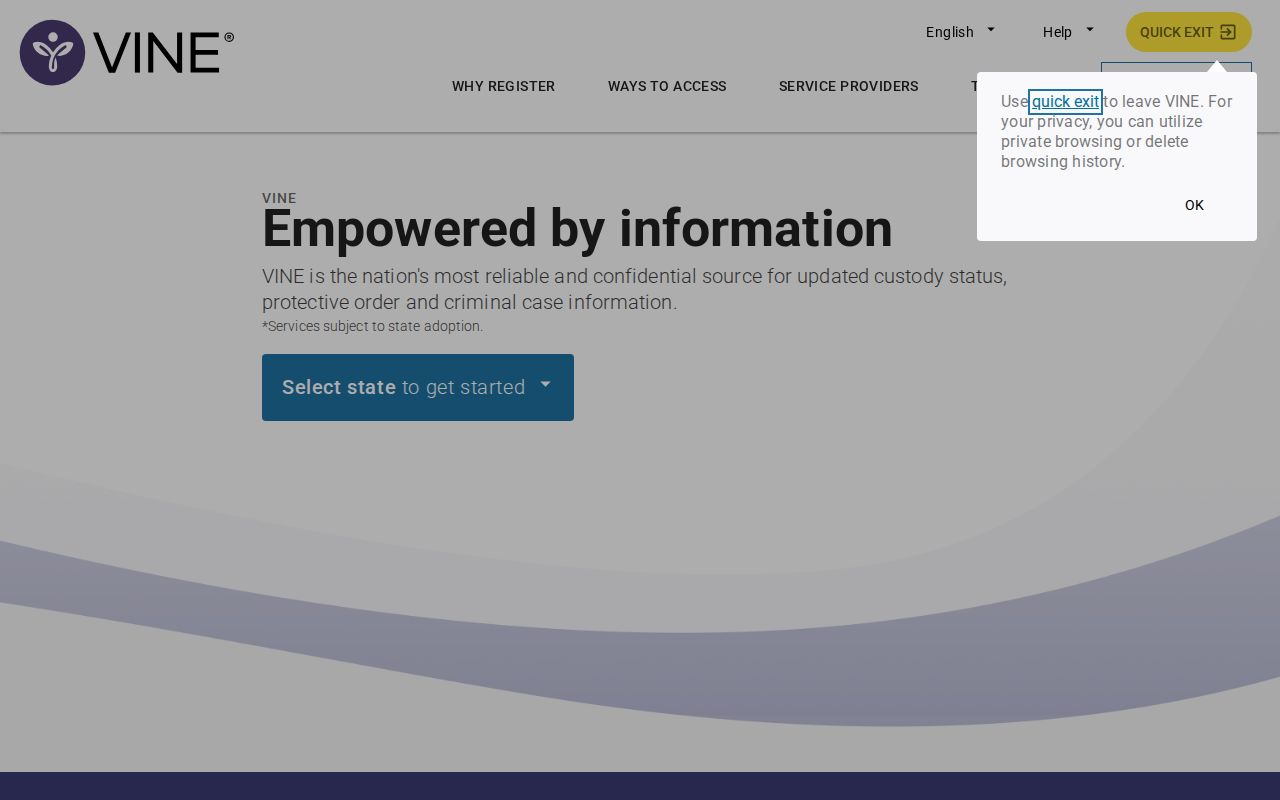
The notification path supplements direct CVRJ confirmation; it does not replace the jail’s release record.
Madison Jail VINE Versus NAAVI
Virginia’s split notification structure is especially important when a Madison person moves from CVRJ into state custody. Jail VINE covers participating local or regional jail custody. VADOC’s NAAVI service handles qualifying victim notifications for the state-prison system. The registrations do not automatically transfer. A user who followed a person at CVRJ may need a new state registration after VADOC assumes custody, and a later move back to a local jail can require new Jail VINE enrollment.
NAAVI distinguishes an “advanced release” notice from an actual “release date” event. The first is an anticipated date and may change. The second means the inmate is no longer in VADOC custody. NAAVI can also cover specified transfer, work release, escape or recapture, death, name change, and parole events within its stated scope. It does not provide local-jail alerts or ongoing notices for probationers and parolees.
Eligible users can review the VADOC notification service or contact Victim Services at 1-800-560-4292 or 804-674-3243, weekdays from 8:30 a.m. to 5 p.m. The successful source capture below shows the VADOC notification channel.
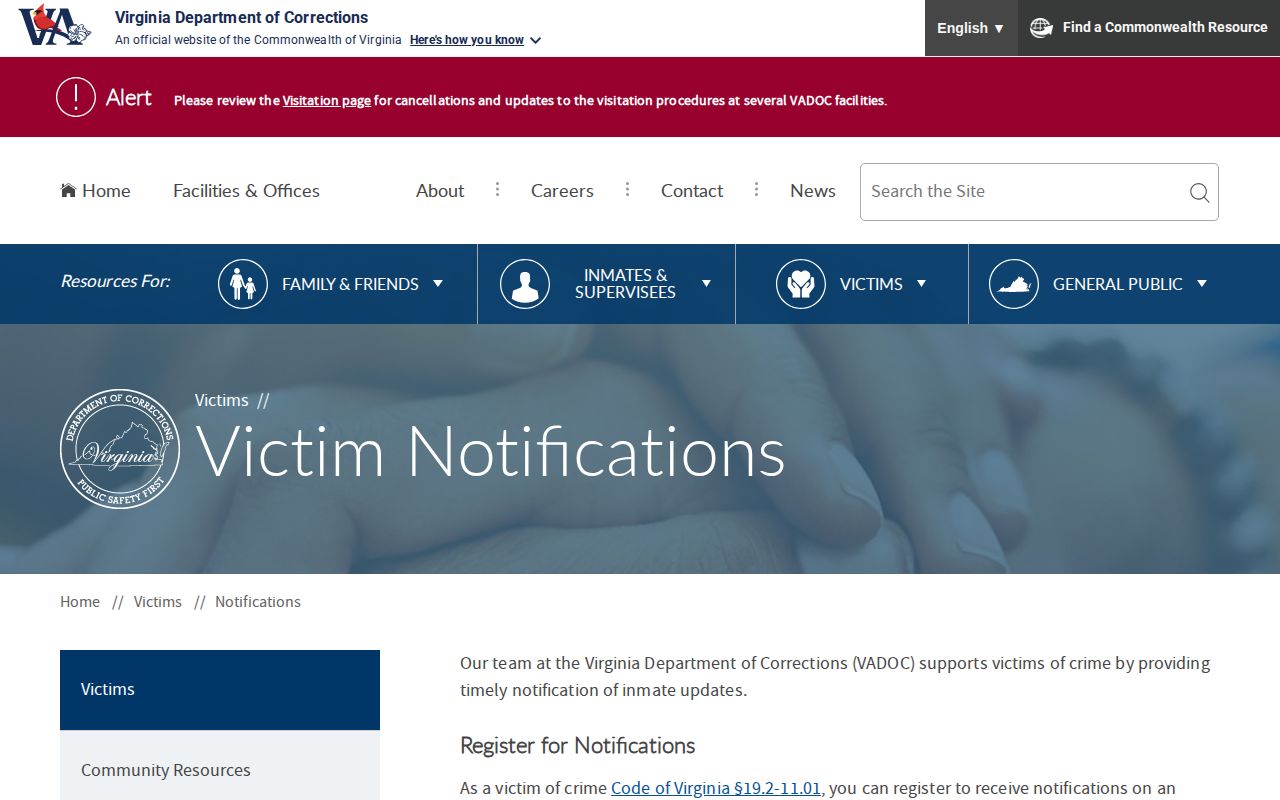
The separate VADOC registration confirms why a local Jail VINE alert should not be expected to follow a person into state custody.
Madison VINELink Search Limits
VINELink does not cover the federal Bureau of Prisons as a substitute federal locator. For a federal sentence, use the BOP Inmate Locator. Federal pretrial detainees may instead be managed by the U.S. Marshals Service, which does not provide a general public roster like BOP’s. A BOP no-result is therefore not proof that a federal defendant was released.
Jail VINE also cannot rule out ICE custody. An immigration detainer may result in CVRJ ending its event while ICE begins a separate one. Use the ICE Online Detainee Locator for a documented immigration transfer. The tools also differ in history: a VINE notification stream ends after release, while BOP retains many former federal records.
A VADOC supervisee result has another nuance. It can confirm that the person left a state prison while showing that correctional control continues in the community. It does not prove full sentence discharge. A person who served only a short CVRJ sentence may never have a meaningful VADOC locator record. Match the search tool to the custody system.
When dates differ, do not choose whichever source appears newest without checking its scope. VADOC describes its public locator as updated daily, while a jail notice may be driven by a participating agency’s event. A projected state release date is not an actual release. A past VINE event is not a certified CVRJ record. Label each date with its source and meaning, and contact the responsible agency when a current status conflicts with an older alert.
ICE’s Madison Release Window
ICE’s official locator can include people released from ICE custody only within the last 60 days. That bounded post-release window is unlike Jail VINE’s notification function and BOP’s generally post-1982 locator history. It matters only when a Madison custody trail includes an actual ICE transfer or detainer. No official source reviewed establishes an ICE detention facility in Madison County.
The ICE locator accepts a nine-digit A-number and country of birth, or exact name, country of birth, and optional birth date. A no-result can reflect spelling, a recent transfer, age restrictions, removal, release outside the window, or system limits. It does not prove community release. If CVRJ reports a transfer to ICE, describe the event as release from CVRJ to ICE custody, then use the separate federal locator and contact route.
The same discipline applies to BOP. Its release date concerns federal custody, not a Madison jail booking. A former federal result can remain visible after BOP custody ends, while Jail VINE is designed around current events and alerts. Keep the agency name with every saved date so records from different systems are not merged into one unsupported timeline.
Note: Keep registrations and records from each custodian because Jail VINE, NAAVI, BOP, and ICE do not form one shared release history.