
Madison 72 Hour Release Window
No distinct 72-hour release feed appears on the Central Virginia Regional Jail site or the Madison County Sheriff’s official pages. The CVRJ site also lacks a public inmate-name roster. As a result, there is no verified web address, publication cadence, photo field, or display-retention period for Madison releases over three days. A current-inmate list from elsewhere must not be relabeled as a release list, and an unofficial county page may mix arrests, current detainees, and old records.
The correct list route is a narrowly bounded request to CVRJ, the regional jail that houses Madison adult detainees. Specify both ends of the 72-hour period and limit the request to Madison commitments. That scope can catch a three-day set of existing entries without asking staff to create a report that does not already exist. For one person, Jail VINE and a CVRJ call remain faster status checks, but neither offers a browsable archive of all releases in the window.
Request Madison’s Three-Day Release Log
Address the request to the CVRJ Custodian of Records, 13021 James Madison Highway, Orange, VA 22960. Call 540-672-3222 to confirm the current submission method. Name the first and last timestamp, state that the request covers Madison County commitments, and ask for existing electronic records. Clear bounds help staff identify a log if one is kept and reduce the risk that records from CVRJ’s other member counties will be swept into the result.
- Choose an exact start timestamp and an exact end timestamp covering 72 hours.
- Ask for existing CVRJ release entries tied to Madison County commitments within those bounds.
- Identify the desired fields, including booking number, release time, disposition, authority, and receiving agency.
- Allow lawful redaction and ask for an estimate before costs exceed a stated limit.
- Compare produced transfer and release entries with the responsible court or successor custodian.
A useful request asks for records, not a new explanation. CVRJ can say whether responsive records exist and whether a field is maintained. Virginia FOIA does not force an agency to create a fresh 72-hour roster. It permits reasonable actual production charges. Under Virginia Code § 2.2-3704, an ordinary response is due within five working days, subject to the statute’s response options and extensions.
The official Madison FOIA instructions can help distinguish a county-agency request from a regional-jail request. View the Madison County FOIA source before choosing the custodian.
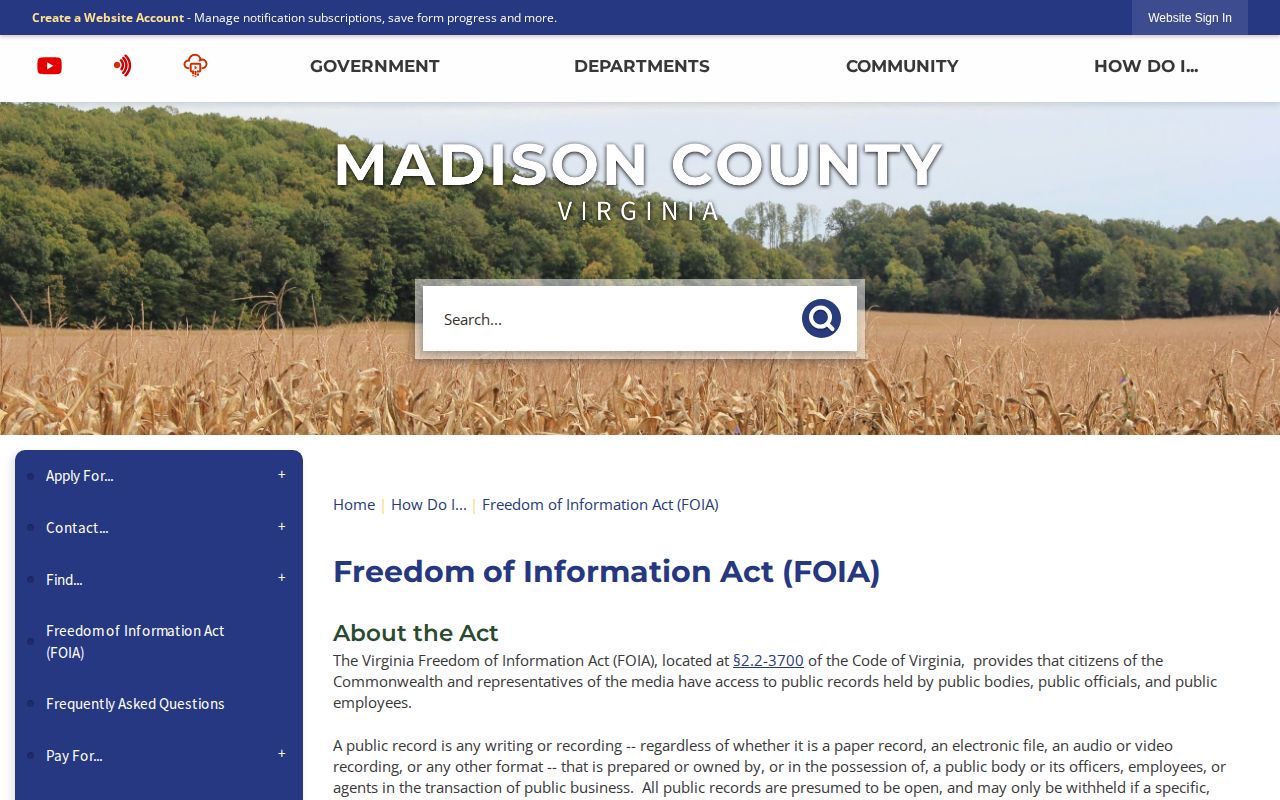
The county page explains request procedure, but CVRJ remains the proper holder for the regional jail’s release log unless another agency confirms it has the record.
Madison 72 Hour Record Fields
There is no online feed whose columns can be copied, so the table below is a request inventory based on the Madison research. Availability depends on what CVRJ actually maintains and may lawfully release. Asking for the booking number and the committing jurisdiction helps distinguish people with similar names and keeps the answer tied to the correct custody episode.
| Field to request | How to read it |
|---|---|
| Name and booking number | Identifies the person and the specific jail event. |
| Madison commitment or agency | Separates Madison records from those of other CVRJ member counties. |
| Release date and time | Places the physical CVRJ exit within the requested three-day span. |
| Release disposition or type | May distinguish bond, time served, court order, discharge, or transfer. |
| Releasing authority | Connects the exit with the court or agency action behind it. |
| Receiving agency or destination | Shows whether custody continued after CVRJ ended its hold. |
Do not place every entry under a single “released” label. Bond is a pretrial exit, not an acquittal. A dismissal may free the person only if no other hold exists. Time served reflects a sentence or credit decision. Transfer to VADOC, another jail, BOP/USMS, or ICE is continued custody. A release record marks the facility event, while the court file explains its legal basis.
Note: If a produced record lacks a disposition or destination, ask the custodian what the field means before drawing a conclusion.
Madison Weekend Release Timing
A three-day window is useful when a target period crosses Friday through Monday or includes a holiday. It can also account for differences between the time a court acts, the time CVRJ finishes processing, and the time another system updates. No official source gives CVRJ release-processing hours, weekend rules, a pickup door, or a guaranteed exit time. The jail’s posted visitation hours are not release hours and should never be used to plan a pickup.
Holidays do not create a known special publication schedule because there is no public feed to refresh. They matter only when choosing the request window and allowing for agency processing. Keep the requested custody period separate from the later date on which an office answers the request.
Use timestamps rather than calendar labels. A request made for “the weekend” may be unclear about whether Friday evening or Monday morning belongs in the range. State the start and end in local time. If the goal is a specific case, compare the CVRJ release time with Madison General District or Circuit Court entries. A bond or final order may explain why an exit was allowed, but a docket is not a door log and may not show when processing ended.
When current timing matters, call CVRJ before traveling. Staff may limit what can be shared by phone, and no public source promises a family waiting point or transportation service. A confirmed record is more reliable than guessing from court hours or another facility’s practices.
Verify a Madison Release Person
Virginia Jail VINE is the immediate local status channel for a matching CVRJ person. Search through VINELink Virginia, compare available identifiers, and record the reporting agency, status, and timestamp. An affirmative release status or alert means the reporting jail ended its custody event. A disappearance or no-result does not. VINE stops updates after release, so retain any notice and request the durable record when the event must be documented later.
If transfer is possible, follow the named system. A VADOC transfer should be checked through the state Inmate and Supervisee Locator after intake. A federal sentence belongs in the BOP locator. An ICE transfer uses the ICE detainee locator. A person under VADOC community supervision has left prison but may not be fully discharged. These systems cannot be blended into one Madison County list because each covers a different custodian and time frame.
The Madison County released inmate search lays out that named-person route in full. For a same-day period rather than three dates, use the Madison Jail Releases: 24 Hours request scope.
Why Madison Release Results Lag
The official CVRJ sitemap confirms there is no verified 24-hour, 72-hour, or other recent-release roster. That fact changes how lag should be described. There is no public CVRJ feed with a promised refresh schedule. VINE supplies agency-fed status for one person, the court portal carries the legal case trail, and a records response supplies the underlying jail entry. Each source answers a separate question on its own schedule.
A no-result can arise from a name mismatch, a transfer, a reporting delay, a custody stream the tool does not cover, or the end of a notification stream. It cannot by itself prove community release. The 72-hour method reduces calendar blind spots, but it does not remove the need to read the disposition and destination fields.
Madison Release Versus Transfer
Madison adults held on local matters enter a regional system that serves five counties and can house local, state, and federal prisoners. That mix makes the destination field crucial. “Released from CVRJ” states only that CVRJ’s custody ended. A community release may follow bond, recognizance, dismissal, time served, sentence expiration, or another order. A handoff to VADOC, another jail, federal authorities, or ICE keeps the person in custody.
| Record result | Next official check |
|---|---|
| Community release | Compare the CVRJ timestamp with the Madison court order or disposition. |
| Transfer to VADOC | Use the VADOC locator after intake updates. |
| Transfer to another jail | Contact the receiving jail and use its official VINE participation path. |
| Federal transfer | Use the federal court record and BOP locator when applicable. |
| ICE transfer | Use the ICE locator or ERO contact path; do not call it community release. |
When one Madison case ends but another warrant or commitment remains, CVRJ may keep custody. That is why a court dismissal alone does not prove a physical exit. The jail event, legal order, and successor-custody check together provide the defensible account.