
Madison Projected and Actual Release
A future date shown for a person still in custody is projected. It reflects the sentence information, credit rules, and legal events known to the calculating authority at that time. The VADOC public locator generally calls its public value a release date. An internal VADOC procedure uses the term projected release date. Do not change the portal's label when recording a result, but treat any future date as subject to change.
An actual release is a completed custody event. It can be proved by a CVRJ release log, VADOC release document, an actual-release notification, or another record from the custodian. A court order may authorize release but does not prove when the jail finished processing or whether a second hold kept the person confined.
Pretrial Madison County detainees are different. Their exit may turn on bond, recognizance, dismissal, a hearing, or a new order. They do not have a sentence-based date to calculate. Check the Madison court docket and CVRJ status instead of asking VADOC to project a local pretrial release.
Find a Madison Release Date
Begin by identifying the sentence and custodian. Adults held on Madison matters are housed through Central Virginia Regional Jail in Orange. A sentenced person transferred into VADOC custody has a state record. The systems overlap during intake, and a transfer from CVRJ to VADOC is continued custody rather than community release.
- Read the Madison sentencing order. Note active time, suspended time, concurrent or consecutive terms, and any jail credit.
- For CVRJ custody, use Virginia Jail VINE for present status and call 540-672-3222. Ask which office can provide the time-computation or release record.
- For state custody, search the VADOC Inmate and Supervisee Locator by DOC ID or name.
- Open the matching result and copy the status, location, DOC ID, and date exactly as the portal labels each field.
- For detailed state calculations, use the VADOC Time Computation information and direct a record question to Court and Legal or the Correspondence Unit.
- Confirm the completed release through CVRJ, VADOC, or an actual-release notice. Do not convert an old forecast into an actual event.
The Madison County released inmate search explains how the jail, courts, VADOC, BOP, and ICE paths differ when the custodian is unclear.
Note: A short local sentence may never create a useful VADOC result, while a state-responsible term can appear only after intake and database updates.
Who Computes Madison Release Dates
Virginia assigns time computation according to sentence type and active term. VADOC calculates active state-responsible sentences longer than 12 months. For that path, correspondence may be sent to VADOC Court and Legal or the Correspondence Unit, P.O. Box 26963, 6900 Atmore Drive, Richmond, VA 23261. The public locator is a useful first view, but it is not the full calculation sheet.
CVRJ is the relevant authority for a short Madison County local sentence. Virginia law requires the jailer to keep commitment, offense, receipt, and term records and to maintain a written earned-credit policy. Ask CVRJ for the existing computation record rather than trying to reconstruct it from a sentence summary. The Madison court clerk supplies the signed order and any amendment.
| Case position | Primary date source | Best confirmation |
|---|---|---|
| Pretrial at CVRJ | Court bond or release action; no fixed sentence date | CVRJ status and release log |
| Local sentence at CVRJ | Jail time computation and court order | CVRJ release record |
| State-responsible sentence | VADOC calculation and public locator | VADOC actual-release record |
| Release to supervision | VADOC date plus supervision status | Release document and District 26 record |
Code § 53.1-28 gives the VADOC Director limited authority to fix a discharge day within 30 days before the normal expiration date for release preparation and scheduling. The official statutory page shows why an arithmetic sentence end is not always the operational date.
Read Virginia's discharge-date authority with the individual VADOC record.
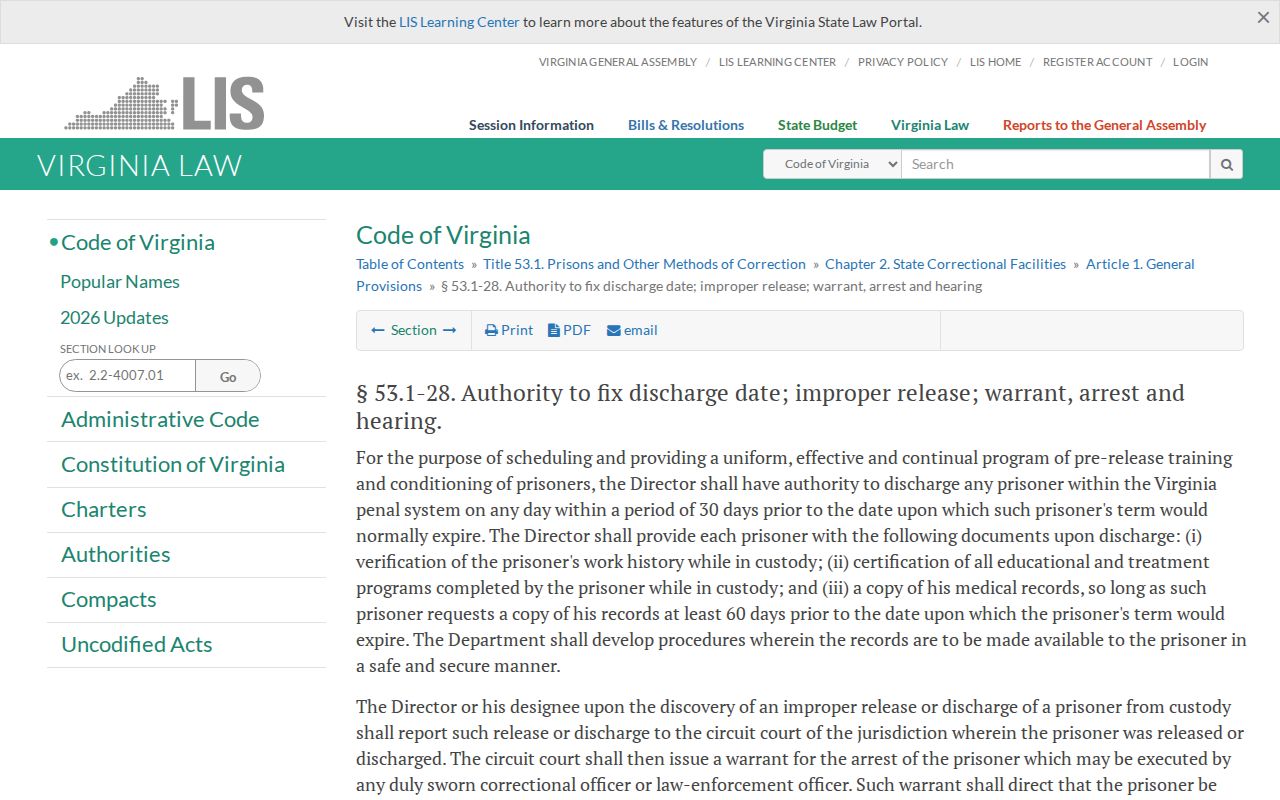
The captured statute supports the scheduling authority, but it does not supply any individual Madison County release date.
Madison Release Credits After 1995
For covered felony offenses committed on or after January 1, 1995, Virginia uses Earned Sentence Credits. Code § 53.1-202.2 establishes that framework and defines one credit as one day deducted. Code § 53.1-202.3 sets the current rates and offense groups.
The serious-offense group named by statute is limited to no more than 4.5 days of credit for each 30 days served. That is the basis for the familiar statement that at least about 85 percent is served. It is not a rule for every Virginia prisoner. Other eligible offenses may fall at 15, 7.5, 3.5, or zero days per 30, based on the statutory group and classification.
Classification changes, discipline, forfeiture, restoration, and legal recalculation can alter earned credits. Credits do not automatically change a parole-eligibility date when the controlling law says otherwise. Mandatory minimums and other sentence terms can also restrict the result.
The official earned-credit source makes the different rates visible.
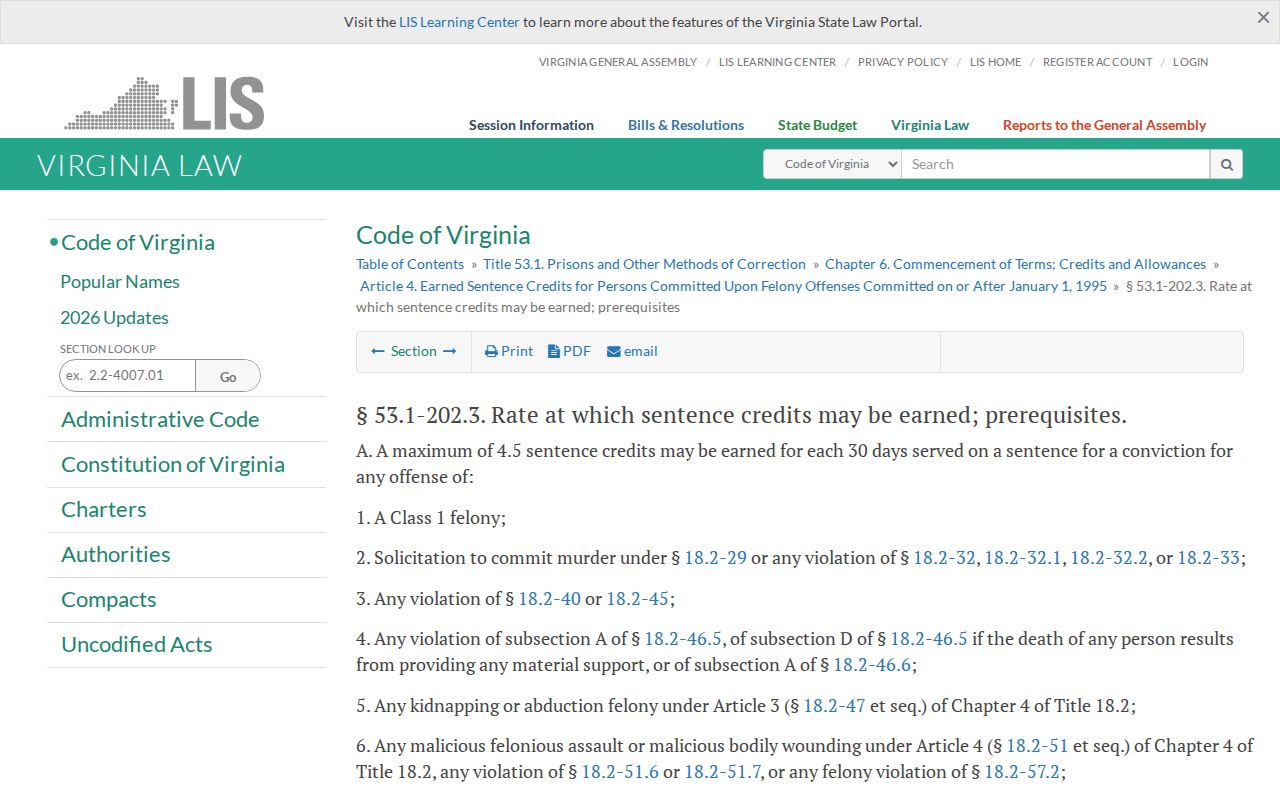
This statute is a framework for VADOC calculations, not a safe basis for a private calculation of one person's release date.
Note: Do not subtract a flat percentage from a sentence; the offense date, offense group, classification, and actual credit record control.
Older and Local Madison Credits
The older Good Conduct Allowance system applies to felony offenses before January 1, 1995 and to certain older misdemeanors. Code § 53.1-199 contains class-based rates. These cases are also more likely to involve parole eligibility. A Good Conduct Allowance date should never be mixed with a modern Earned Sentence Credit calculation.
Local jail credit follows its own path. Under Code § 53.1-116, a person sentenced to 12 months or less for a misdemeanor generally earns one day of credit for each day served while following jail rules, unless a mandatory minimum applies. The jailer may apply other credits authorized by the law for qualifying work, classes, or local programs. Violations can add deductions back.
Code § 53.1-187 addresses qualifying presentence confinement tied to the offense. Time at liberty on bail does not count. The final court order, CVRJ computation sheet, and jail release record are the proper inputs for a Madison local term.
Why Madison Release Dates Move
A date can change after the first public display. Some changes correct the calculation. Others reflect later conduct, a new court order, or another agency's authority. A transfer or detainer can also mean that one custodian ends its hold while another immediately begins custody.
| Factor | Effect on the projected date | Record to check |
|---|---|---|
| Earned-credit class | A different statutory rate changes deductions | VADOC computation record |
| Discipline | Forfeiture or later restoration can move the date | Agency credit calculation |
| Corrected jail credit | Verified presentence days can revise active time | Sentencing order and computation sheet |
| Amended sentence | A court can change active or suspended terms | Signed court order |
| Concurrent or consecutive terms | Sentence structure changes the total | Judgment orders and legal calculation |
| Detainer or hold | The person may leave one system but remain confined | Release destination and receiving agency |
| Parole action | An eligible case may gain or lose a conditional release path | Board decision and VADOC record |
Weather and operations can affect the hour as well. VADOC states that a discharge or parole release occurs by 11:59 p.m. on the scheduled date, weather permitting. That rule applies to VADOC facility releases. It does not establish CVRJ release hours, and the jail's posted visitation blocks are not release-processing times.
Madison Projected Release Alerts
Notification depends on custody. Virginia Jail VINE covers people held at CVRJ and participating local or regional jails. VADOC uses NAAVI for eligible state-custody victim notifications. Enrollment does not pass from Jail VINE to NAAVI when a person transfers into state custody.
NAAVI defines an advanced release notice as an anticipated date, generally issued about 30 days ahead and updated when the date changes. Its release-date event means the person is no longer in VADOC custody. That distinction is useful: the first alert is a forecast, while the later event reports an actual change in custody.
For the local-jail notification steps, use the Madison County VINELink inmate search. A VINE alert still needs a CVRJ check when the event might be a transfer. Jail VINE stops its stream after release, so retain the notice and obtain the official release record for lasting proof.
Prove a Madison Actual Release
Use the record created by the custodian that completed the event. For CVRJ, ask for the release date and time, release authority or type, and receiving agency for any transfer. For VADOC, obtain the release document or public record tied to the DOC ID. Then compare the result with the signed order from the Madison Circuit Court criminal division.
A release record and a court record serve different purposes. The facility log proves the physical custody change. The order explains the legal basis, sentence, credit terms, or bond act. When their timestamps differ, preserve both instead of forcing them into one date.
Virginia also requires formal agency notice around a state release. Code § 53.1-160 directs VADOC to notify specified courts and law-enforcement or prosecutorial officials before a prisoner's release or discharge. The notice can include the offenses, terms imposed, and commitment date. It is an agency-to-agency record, not a public release calendar, yet it confirms that the actual state release produces records beyond the web locator. A focused VADOC request may therefore be more durable than a saved search screen.
Final discharge may occur after release to District 26 supervision. A supervisee record means the person left prison but remains under VADOC authority. Do not describe that status as sentence completion. Ask for a discharge record when the end of all correctional control is the fact that matters.